
India’s trade partnerships in 2026 signal a decisive shift toward deeper global economic integration, supported by a broad network of modern and outcome‑oriented trade agreements. India’s role and share in global trade are poised for a major leap in line with the country’s ambition and journey towards Viksit Bharat, following decades of increasingly deep integration with global markets, strong export performance, resilient services trade, and an expanding network of trade partnerships.
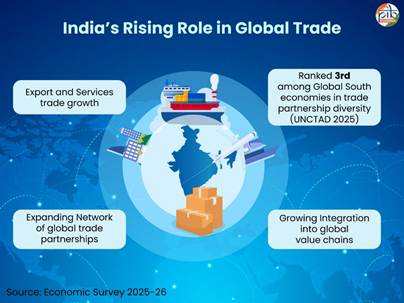
India has not only increased its share in global trade but has also diversified its trading partnerships. According to UNCTAD’s Trade and Development Report 2025, India ranks third among Global South economies in terms of the diversity index of trade partnerships. With an index score higher than that of all countries in the Global North, India’s trade ecosystem is seen as resilient in the face of tariff uncertainties and emerging global challenges. An expanding network of free trade agreements strengthens India’s trade strategy by ensuring reliable market access and helping export‑oriented firms expand production and integrate more deeply into global value chains.
In the fiscal year 2025–26, India advanced its trade engagement by concluding FTAs with the United Kingdom, Oman, and New Zealand, marking a significant expansion of economic partnerships across key global markets. Alongside these new agreements, India has, over the past few years, operationalised several major trade pacts, including the India–UAE Comprehensive Economic Partnership Agreement, the India–Australia Economic Cooperation and Trade Agreement, and the India–EFTA Trade and Economic Partnership Agreement, each of which continues to support export growth and investment flows. The India–UAE CEPA, in particular, has already helped bilateral trade surpass USD 100 billion in FY 2024–25, empowering MSMEs and supporting job creation.
The India–European Free Trade Association (EFTA) TEPA, effective from October 2025, provides market access covering 92.2 per cent of tariff lines, accounting for 99.6 per cent of India’s exports, and opens new opportunities for Indian IT and services‑sector firms overseas. Meanwhile, landmark negotiations with the European Union and other key economies reflect an expanding negotiation agenda aimed at deepening trade and investment ties through FTAs and comprehensive economic partnerships. Together, these efforts position India as a trusted and dynamic partner in global trade, driving sustainable growth and shared prosperity in the years ahead.
India’s trade partnerships power global integration and growth


RELATED ARTICLES
