

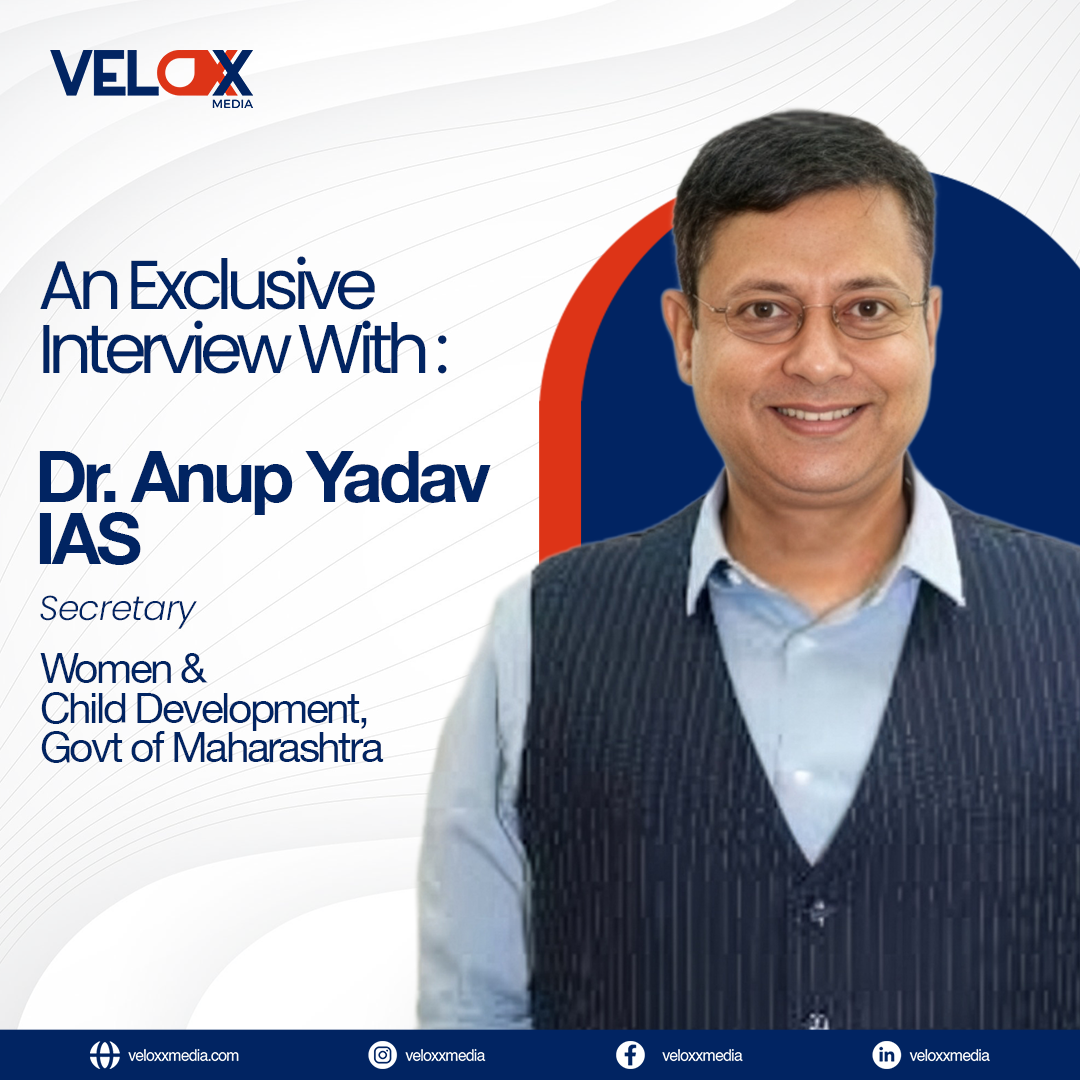
In this exclusive interview with Veloxx Media, Dr. Anup Kumar Yadav, IAS, Secretary, Women and Child Development Department, Government of Maharashtra, shares his vision of transforming the department from a welfare-driven system into a holistic human development engine. He highlights Maharashtra’s progress in nutrition, Anganwadi strengthening, and service delivery, while emphasizing convergence across health, sanitation, and community awareness. He also underscores the shift toward long-term empowerment, ecosystem-based development, and the use of technology to drive transparency, efficiency, and impactful outcomes for women and children
Below are the given edited excerpts:
- As Secretary of the Women and Child Development Department in Maharashtra, how do you define the department’s role today – is it mainly about welfare delivery, or is it increasingly about shaping long-term human development through nutrition, safety, education, and empowerment together?
- The Women and Child Development Department (WCD), Government of Maharashtra, is no longer limited to welfare delivery alone. Today, WCD directly and indirectly influences the lives of nearly 70% of the State’s population, positioning it as a core driver of human development. With a strategic focus on the first 1,000 days of a child’s life—from a woman’s pregnancy to early childhood—the Department intervenes at the most critical stage of human capital formation. Through interventions spanning maternal nutrition, health, early childhood care and education (ECCE), education‑linked schemes like lek ladki scheme, and financial assistance under the Balsangopan scheme, WCD lays the foundation for a child’s physical and social development. Beyond early childhood, the Department ensures care, protection, and rehabilitation of Children in Need of Care and Protection (CNCP) through institutional and non‑institutional mechanisms, while also administering shelters and after‑care support systems. Simultaneously, WCD plays a central role in implementing key social legislations, including the Prohibition of Child Marriage Act, Dowry Prohibition Act, Domestic Violence act, POSH act etc, thereby safeguarding the rights, dignity, and future of women and children. Schemes such as Ladki Bahin financial support further strengthen women’s economic agency, reinforcing the link between social security and long‑term empowerment. Taken together, these interventions demonstrate that WCD today actively shapes a child’s life trajectory and career outcomes from the very beginning.
- Given Maharashtra’s diverse district realities and social context, how do you assess the current status of women and children in the state? In your view, where has meaningful progress been made, and which areas still demand more focused and urgent attention?
- In last few years, we focused on strengthening nutrition delivery and outcomes under ICDS with measurable impact. We ensured consistent supplementary nutrition coverage for nearly 58–59 lakh beneficiaries, including children aged 0–6 years and pregnant and lactating women, across both rural and urban Anganwadi centres. At the same time, system efficiency was significantly improved—growth monitoring reached over 99% by December 2025. These efforts translated into tangible nutrition outcomes. The prevalence of Severely Acute Malnutrition declined from 1.93% in 2023 to 0.36% by end‑2025, while Moderate Acute Malnutrition reduced from 5.09% to 2.40%. We also saw major improvements in other key indicators, with severe stunting and severe under‑weight nearly halving during this period. Severely malnourished children were proactively managed through VCDC and UCDC admissions with Energy Dense Nutritious Food support. Parallelly, we strengthened the Anganwadi ecosystem—over 3,000 frontline vacancies were filled, home‑visit coverage rose from 35% to 99%, and community ownership was built through more than 2.18 lakh nutrition‑focused community‑based events. Together, this ensured both scale and outcomes in child nutrition.
- You have spoken about nutrition as something shaped not only by food, but also by health, sanitation, awareness, and behaviour. In practical governance terms, what does that kind of convergence really require on the ground?
- Through Community‑Based Events (CBEs) conducted twice a month at the Anganwadi level and Village Health, Sanitation and Nutrition Days (VHSNDs) held once a month, we ensure regular counselling and awareness among women and children on sanitation, nutrition, and healthy food habits, leading to sustained behaviour change at the community level. Apart from this, IEC material such as videos, posters are used for better and easy understanding of sanitation.
- At the national level, programmes such as Mission Shakti, Mission POSHAN 2.0, PMMVY, and Mission Vatsalya are shaping the broader framework for women and child development. Where do you see the strongest alignment between these central initiatives and Maharashtra’s own priorities?Mission Shakti itself is framed around women’s safety, security, and empowerment, with a convergence-led, life-cycle approach to women-led development.
- Mission Shakti, Mission POSHAN 2.0, PM Matru Vandana Yojana (PMMVY), and Mission Vatsalya together form a comprehensive umbrella that follows a life‑cycle approach for women and children—from nutrition and health in early childhood to protection, education, and empowerment. In alignment with the Central Government’s objectives, Maharashtra has complemented these frameworks with additional state‑specific financial support schemes such as Ladki Bahin for women and Balsangopan for children in need of care and protection, ensuring last‑mile economic security. To address structural issues like child marriage and to promote girl‑child education, the State launched the Lek Ladki scheme, which incentivises education and delays early marriage. Parallelly, women’s economic empowerment is being strengthened through robust Self‑Help Group mobilisation via MAVIM and livelihood‑oriented initiatives such as the Pink E‑Rickshaw scheme, enabling sustainable income generation and financial independence. Schemes such as Mukhyamantri Mazi Ladki Bahin Yojana have brought women’s economic support into sharper public focus.
- From your perspective, how should Maharashtra think about the next step – beyond financial assistance alone – so that welfare support translates into stronger agency, health, and long-term empowerment? The Maharashtra WCD department lists the scheme among its major state initiatives.
- Field observations indicate that the financial assistance provided under the Ladki Bahin scheme is being responsibly utilised by beneficiaries, primarily for essential needs such as healthcare and education. Importantly, we are now witnessing an encouraging transition—from consumption support to livelihood creation. In Nagpur, for instance, more than 30 women pooled their Ladki Bahin assistance to form a small credit society, enabling access to micro‑capital and collective economic activity. Such examples reflect the scheme’s potential beyond income support. Our expectation is that this assistance should enhance women’s financial independence, strengthen their decision‑making capacity within households, and gradually translate into sustainable livelihoods by multiplying the initial support through collective and entrepreneurial efforts.
- Maharashtra has one of the largest Anganwadi ecosystem in India, and there is growing emphasis on Saksham Anganwadi and Mission POSHAN 2.0. In your view, what should the next-generation Anganwadi centre in Maharashtra really become – a nutrition point, an early childhood learning space, a family support platform, or all of these together?
- All these initiatives come together as part of the long‑term roadmap envisioned under Vikasit Maharashtra Vision 2047. Our approach is to move from scheme‑based delivery to ecosystem‑based human capital development. In this direction, we are planning to transform more than 80,000 Anganwadi centres into Smart Anganwadi Centres, equipped with improved infrastructure, digital tools, and enhanced service delivery for nutrition, health, and early learning. Simultaneously, we are working closely with the School Education Department to strengthen Early Childhood Care and Education (ECCE) and ensure a seamless transfer of child from Anganwadi to formal schooling. This convergence is critical to ensure that investments made during the first 1,000 days of a child’s life translate into better learning outcomes and life opportunities. Together, these efforts reflect a shift from welfare to capability building—where Anganwadis act as the foundation of lifelong learning, health, and empowerment for women and children in Maharashtra.
- Child protection is often discussed mainly in terms of rescue and response, but the deeper challenge is prevention. In Maharashtra, how do you see the department strengthening the ecosystem around child safety, foster care, family-based care, and the prevention of child marriage in a more sustained way?The department’s site publicly highlights both foster care and child-marriage prevention initiatives.
- Our primary focus is on strengthening non‑institutional care so that children can grow up in family‑ and community‑based environments rather than institutions. Under non‑institutional care, we are working mainly on three pillars: financial support to Children in Need of Care and Protection (CNCP), promotion of adoption and foster care, and education‑linked financial incentives. Through the Balsangopan scheme, we provide monthly financial support to CNCP children, which helps families care for children at home and avoids unnecessary institutionalisation in Child Care Institutions (CCIs). Parallelly, we are placing strong emphasis on adoption and foster care. Maharashtra has consistently performed well in adoption outcomes, which has also been appreciated by the Central Government, reflecting the robustness of our child protection ecosystem. To prevent child marriage and keep children within a protective safety net through schooling, we have introduced the Lek Ladki scheme—an education‑linked incentive model that encourages continued education, delays early marriage, and strengthens long‑term child protection outcomes. Overall, our approach is to shift from institutional dependency to family‑based care, education, and financial security.
- Technology is becoming more important in this space – from eKYC and DBT systems to data platforms and real-time monitoring. How do you see digital tools, and possibly even AI, improving women-and-child development outcomes without making the system more difficult for frontline workers or beneficiaries at the last mile?
- Technology has played a critical role in improving both efficiency and credibility of our welfare delivery systems. Processes such as e‑KYC have enabled instant verification of beneficiary details like name, address, age, and gender, significantly reducing errors and duplication. The Direct Benefit Transfer (DBT) architecture has eliminated intermediaries by transferring funds directly into Aadhaar‑seeded beneficiary accounts within seconds, ensuring transparency and timeliness. Additionally, the use of AI has made application scrutiny faster and more effective by automating checks, flagging inconsistencies, and supporting decision‑making. Overall, technology—particularly AI—has transformed our systems into quicker, more accurate, and more reliable platforms. In fact, the State’s ability to roll out the Ladki Bahin scheme and deposit benefits into beneficiaries’ accounts within just a few weeks was possible only because of this strong digital infrastructure.
- One of the key questions in social-sector governance is whether schemes are succeeding only administratively or also developmentally. In your view, how should Maharashtra measure real progress in women and child development – by enrolment and disbursement numbers, or by deeper outcomes such as nutrition, safety, delayed marriage, school retention, and women’s decision-making power?
- The true measure of success of any programme or scheme lies not in distribution alone, but in the outputs and long‑term impact it creates. Mere disbursement of benefits does not automatically translate into meaningful outcomes. That is why, before rolling out any scheme, it is essential to design clear and measurable Key Performance Indicators (KPIs) to track progress and effectiveness. In addition to quantitative monitoring, qualitative assessment is equally important. Reviewing a representative sample of beneficiaries helps us understand whether the intervention is actually improving lives on the ground. Most importantly, social audits should be institutionalised as an integral part of implementation, rather than treated as an add‑on after rollout. In my view, impact measurement, beneficiary feedback, and social audits must be planned upfront and embedded into scheme design itself. This approach ensures accountability, mid‑course correction, and ultimately, real social transformation.
- Looking ahead, where do you believe Maharashtra can set a stronger example for the country in women and child development – whether in nutrition, adolescent girls, digital governance, child protection, or women’s economic and social empowerment?
- In many aspects, Maharashtra is well‑positioned to set a national example. The State benefits from strong and sensitive leadership, complemented by equally committed and responsive field‑level functionaries. This combination ensures that policies are not only well‑designed but also empathetically implemented on the ground. With rapid adoption of digital platforms and the increasing use of advanced technologies such as AI, Maharashtra has the institutional capacity to lead in ensuring the safety, protection, and empowerment of women and children. Together, leadership, field sensitivity, and technology form a powerful ecosystem that enables effective, transparent, and impactful governance.

