

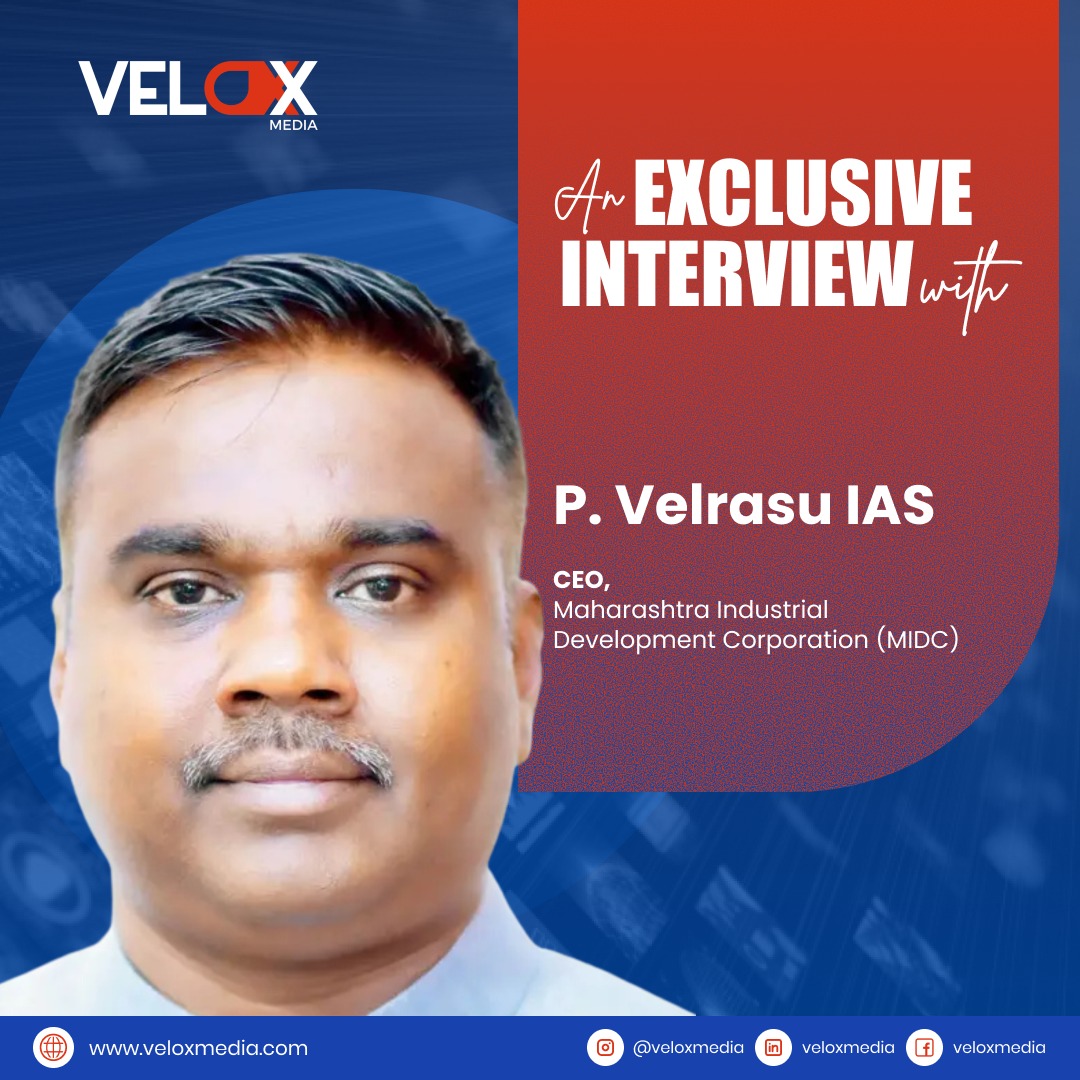
A Veloxx Media Interview Feature
Featuring
P Velrasu, IAS
2002-batch Indian Administrative Service
Chief Executive Officer
Maharashtra Industrial Development Corporation (MIDC)
Pre-Interview Editorial Context
Established in 1962, the Maharashtra Industrial Development Corporation (MIDC) today manages over 1.3 lakh hectares of industrial land across more than 280 industrial areas, making it India’s largest state-run industrial development agency by scale of developed industrial land. Few sub-national institutions globally operate industrial ecosystems of this breadth under a single statutory mandate.
MIDC’s industrial estates support a significant share of Maharashtra’s manufacturing base, export-oriented industries, and emerging high-growth sectors. This institutional scale becomes especially consequential as Maharashtra pursues its ambition of becoming India’s first $1-trillion state economy, contributing materially to the country’s broader $5-trillion economic goal. Unlike many industrial authorities worldwide, MIDC integrates land development, utility provisioning, environmental infrastructure, and investor facilitation within a single institutional framework-enabling continuity between policy intent and on-ground execution.
This interview features P Velrasu, a 2002-batch IAS officer whose career spans urban governance, large public institutions, and infrastructure systems. As CEO of MIDC, he represents the administrative layer where industrial policy is operationalised across sustainability, digital governance, sector-specific clusters, and regionally balanced growth. Against this backdrop, the conversation examines how institutional capacity, technology, and long-term planning are being aligned to support Maharashtra’s next phase of industrial development.
In this sense, MIDC represents a distinct global model, not a replica of international peers, but an institution shaped by India’s scale, diversity, and long-term industrial ambition.
All responses below are reproduced exactly as shared, preserving the clarity, intent, and technical depth of the interviewee’s views.
1)As CEO of MIDC, what is your long-term vision for industrial development in Maharashtra?
As the CEO of MIDC, my long-term vision for industrial development in Maharashtra aligns with the state’s goal of achieving a $1 trillion economy by 2030. MIDC’s strategy is to build a future-ready industrial ecosystem focused on sustainability, technology, and inclusive growth. We are expanding world-class infrastructure through strategic land acquisitions and by developing new industrial zones in regions such as Dighi–Mangaon, Chhatrapati Sambhajinagar, Nagpur, and Nashik. Additionally, we are creating over 50 sector-specific clusters in key industries including pharmaceuticals, textiles, semiconductors, electric vehicles, data centers, advanced manufacturing, and chemicals.
Through initiatives like Magnetic Maharashtra, the MILAAP portal, and single- window system, we aim to boost investor confidence and simplify the ease of doing business. Maharashtra’s leadership in foreign direct investment and exports supports this goal. Sustainability plays a central role in our roadmap, with an emphasis on green technologies, renewable energy integration, and the operation of 38 common effluent and hazardous waste facilities for key industries.
Our vision also focuses on balanced regional development beyond traditional hubs like Mumbai, Pune, and Thane, extending support to aspirational districts such as Gadchiroli. Moreover, we are committed to workforce development through strong industry-academia partnerships to nurture talent for next-generation sectors.
This comprehensive approach positions Maharashtra to become India’s first trillion-dollar state economy and a global center for advanced, green industrialization, driving inclusive prosperity for all through sustainable industrial growth.
2) Is MIDC aligning its priorities with the national “Make in India” and “Atmanirbhar Bharat” missions?
MIDC’s priorities are fully aligned with the national missions of “Make in India” and “Atmanirbhar Bharat,” as well as Maharashtra’s “Viksit Maharashtra 2047” vision. Guided by the State Industrial Policy, our approach focuses on creating world-class infrastructure,
promoting domestic manufacturing, and embracing Industry 4.0 technologies under the Magnetic Maharashtra brand.We actively support key national programs such as the National Industrial Corridor Development Programme (NICDP), with Maharashtra hosting important nodes like Dighi and Shendra-Bidkin within the Delhi-Mumbai Industrial Corridor. These greenfield smart cities offer plug-and-play facilities and multi-modal connectivity to enhance global competitiveness.
Our commitment is reflected in dedicated sector-specific clusters developed under flagship schemes. For example, the Mega Leather Footwear and Accessories Cluster at Ratwad Industrial Area covers 153 acres, expected to boost exports under the Indian Footwear Leather Development Programme (IFLDP). Similarly, the Electronics Manufacturing Cluster at Ranjangaon, spread over 297 acres with a ₹492.85 crore investment, is projected to attract ₹2,000 crore in investments and create 5,000 jobs, positioning Maharashtra as a hub for semiconductors and advanced electronics.
By promoting automation, digital systems, and smart manufacturing, along with hosting data centers, defense units, and R&D facilities, MIDC is driving innovation, self- reliance, and global competitiveness. This strategic alignment ensures Maharashtra remains a key driver in India’s industrial transformation, supporting the country’s goals of manufacturing excellence and economic self-sufficiency.
3) How is MIDC leveraging digital technology – AI, GIS, real-time dashboards – to drive precision planning and monitoring?
MIDC is embracing digital technologies like AI, GIS, and real-time dashboards to make planning and monitoring more precise and efficient.
We’re actively leveraging AI to transform investor engagement and streamline communication. We are developing AI-powered multilingual chatbots that provide personalized, 24/7 assistance across several languages, helping investors from MSMEs to large enterprises navigate land application processes and access real-time updates on available plots and regulations. These AI systems will support our internal teams by intelligently scanning and summarizing important documents and circulars, providing quick access to critical policy changes and vital information. At the same time, they will deliver transparent, user-friendly information to the public in regional languages. Through these initiatives, we are creating an inclusive, data-driven ecosystem that enhances ease of doing business and empowers all stakeholders with timely, accurate, and easily accessible information.
We have also utilized advanced GIS technology to develop a unified spatial data platform that seamlessly integrates industrial estate layouts, utility networks, and real-time satellite imagery. This platform empowers investors to visually inspect available plots, ensuring transparency and boosting confidence throughout the land allotment process. Our GIS system aligns with broader state and national infrastructure plans, enabling us to make precise, data-driven decisions that support sustainable industrial growth. In addition, real- time GIS dashboards provide our leadership with actionable insights, strengthening monitoring, compliance, and proactive interventions across Maharashtra’s industrial areas.
Alongside AI & GIS, MIDC has developed various role-based real-time dashboards that offer comprehensive insights into key functions such as single window clearance, RTS services, and utility billing. These dashboards enable our leadership to actively monitor breached timelines, identify approaching deadlines, and receive actionable insights to facilitate early intervention helping us avoid delays. They provide MIDC management with the tools to track progress, pinpoint bottlenecks, and highlight roadblocks across departments and regions. By delivering transparent, data-driven visibility across the organization, these dashboards empower faster, more informed decision-making and significantly enhance overall operational efficiency. Together, these technologies are transforming MIDC into a more transparent, responsive, and effective organization better able to serve industries, investors, and citizens now and into the future.
4) With Industry 4.0 transforming manufacturing, how is MIDC enabling tech-driven industries and startups to flourish?
MIDC is at the forefront of driving Maharashtra’s Industry 4.0 transformation by developing specialized industrial parks and sector-specific clusters tailored for high-tech industries such as semiconductors, electric vehicles (EVs), electronics, and renewable energy. These initiatives are supported by targeted policy incentives including capital subsidies, tax reliefs, and duty exemptions to attract and nurture investment.
We actively foster global partnerships with leading technology companies and research institutions to promote innovation, knowledge transfer, and development of cutting- edge solutions. Our focus on sustainability is reflected in the promotion of clean energy and green hydrogen projects aligned with Environmental, Social, and Governance (ESG) principles.
Maharashtra’s progressive policies further strengthen this ecosystem. The new Data Center Policy, under the IT & ITeS Policy 2023, positions Mumbai as India’s “Data Center Capital,” targeting 1.5 GW of green data center capacity and attracting investments worth ₹1.6 lakh crore, with the state already hosting 60% of India’s data center capacity. Similarly, the AVGC-XR Policy 2025 aims to make Maharashtra a global hub for animation, gaming, virtual reality, and immersive technologies. The GCC Policy 2025 seeks to establish 400 new Global Capability Centers and generate 4 lakh skilled jobs by promoting clusters in AI, FinTech, MedTech, and ClimateTech across Tier-2 and Tier-3 cities.
To support startups and MSMEs, MIDC provides flexible infrastructure options such as flatted galas, pre-approved sheds, and priority allotments for women, SC/ST, and differently-abled entrepreneurs. Simplified processes including single-window clearances and e-bidding ensure transparency and ease of doing business.
Initiatives like Magnetic Maharashtra have already facilitated Memorandums of Understanding (MoUs) worth ₹15.7 lakh crore, underscoring the state’s investment potential. By integrating Industry 4.0 technologies with sustainability and inclusive policies,
MIDC is building a future-ready industrial ecosystem where global enterprises, startups, and innovators can thrive and contribute to Maharashtra’s economic growth.
5) How is MIDC ensuring that industrial development is balanced across districts and not just focused in urban belts?
MIDC is dedicated to ensuring balanced industrial development across Maharashtra by expanding focus beyond the traditional urban belts of Mumbai, Pune, and Thane, in line with Maharashtra’s Industrial Policy 2019 and the “Viksit Maharashtra 2047” vision. We are developing sector-specific clusters in emerging and aspirational districts to unlock regional growth and create inclusive opportunities.
Key projects include the PM MITRA Textile Park in Amravati, spanning 1,020 acres; the Bulk Drug Park in Raigad; electronics hubs at Ranjangaon; aerospace and defense clusters in Nagpur and Shirdi; and mega food parks in Ratnagiri. In addition, we promote specialized industries such as gems, wine, leather, and logistics across various regions.
To encourage equitable growth, MIDC implements area-wise incentives offering benefits like up to 20% MSME waivers, export advantages, and priority land allotments allocating 20% each for MSMEs and SC/ST and Nav Budha entrepreneurs, 5% each for women and persons with disabilities, and 2% for ex-servicemen through a transparent e- bidding process. Aspirational district such as Nandurbar receive targeted incentives aimed at attracting investment and creating local employment.
Our efforts also integrate major connectivity projects like the Samruddhi Mahamarg and key nodes under the National Industrial Corridor Development Programme (NICDP), enhancing access and logistics across regions. By fostering inclusive opportunities for startups and underrepresented groups, MIDC is building a regionally balanced and sustainable industrial ecosystem that drives growth and prosperity throughout Maharashtra, extending well beyond its urban centers.
6) What can industries, investors, and citizens expect from MIDC in the next 3–5 years?
Over the next 3 to 5 years, MIDC will accelerate Maharashtra’s transformation into a diversified, next-generation industrial leader, advancing the state’s vision of becoming India’s first trillion-dollar economy. We are focused on expanding world-class infrastructure through strategic land acquisitions and developing new industrial parks under Public-Private Partnership (PPP) models to attract global investments and strengthen Special Economic Zones (SEZs).
Our efforts include establishing specialized clusters for high-growth sectors such as semiconductors, electric vehicles (EVs), green hydrogen, artificial intelligence, cloud computing, and advanced electronics. These will be supported by centers of excellence, R&D hubs, and innovation ecosystems designed to nurture startups and MSMEs through plug- and-play facilities, financial incentives, and dedicated incubation programs.
Sustainability will remain at the core of our development agenda, with the creation of green industrial cities modeled on successful projects like AURIC, integrating smart utilities, clean energy solutions, and circular economy principles. To boost supply chain efficiency, we are enhancing multi-modal logistics infrastructure by leveraging National Industrial Corridor Development Programme (NICDP) nodes and improving connectivity through projects like the Samruddhi Mahamarg.
Collaborations with academic institutions will ensure a skilled workforce equipped to meet the demands of Industry 4.0 sectors. Through transparent e-bidding processes, inclusive allotment policies, and the expansion of PPP-driven industrial parks, MIDC is committed to fostering a future-ready Maharashtra that balances global competitiveness with equitable regional growth and sustainable industrial development. Industries, investors, and citizens can look forward to a robust ecosystem that drives innovation, prosperity, and inclusive progress across the state.
ABOUT THE SERIES
This conversation is part of Veloxx Media’s Leadership Interview Series, featuring voices and insights from key figures in public institutions and industry bodies shaping India’s economic and institutional future.

