

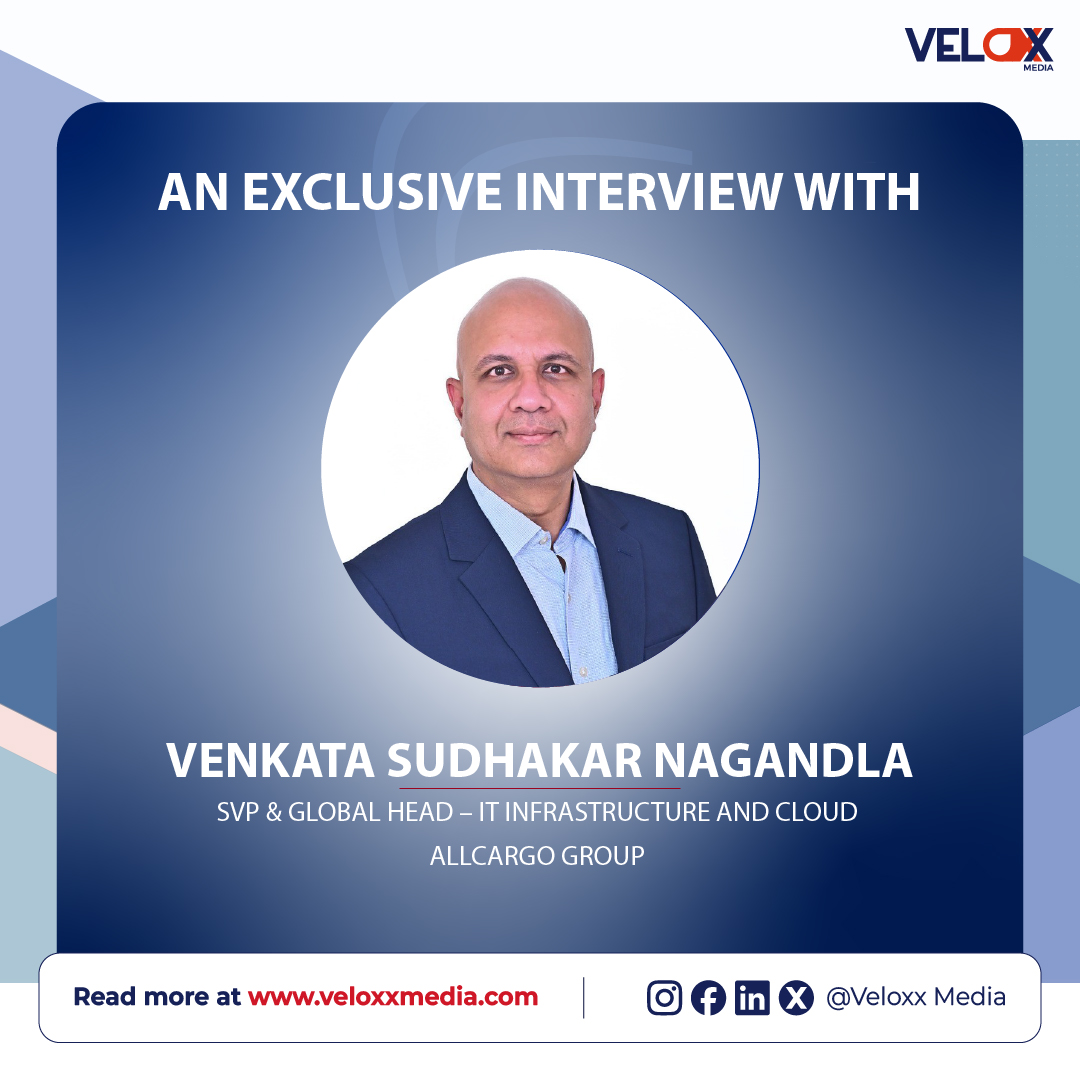
1.You have worked across IT infrastructure and technology-led transformation. What has been the biggest shift you have witnessed in how enterprises approach IT over the years?
The biggest shift has been the transition of IT from being a support function to becoming a strategic business enabler. Virtualization, Cloud, SaaS, Cybersecurity and most recently AI have dramatically accelerated this transformation. The conversation has smoothly moved from “What technology should we deploy?” to “What business outcome are we trying to achieve, and what is the most effective technology model to deliver it?”
In the late 1990s and early 2000s, especially IT infrastructure conversations were largely about the availability, stability, capacity and cost containment. For the end users and the developers alike, an IT Infrastructure engineer’s primary visibility came during maintenance windows or high-profile remediation efforts like Y2K patch exercise.
In today’s environment, there are three major shifts that I see
i. Alignment with business – Technology is expected to contribute to business agility, better customer experience, innovation, operational efficiency and competitive advantage. IT Infrastructure strategy, planning and design gets initiated keeping that business requirement at the center
ii. The shift from ownership to consumption model – From the traditional approach of building and owning the data center, server, storage, network, security layers to consuming the service and paying for what we use – helped with the needed flexibility for Commissioning and Decommissioning alike
iii. The most recent shift has been driven by AI. Intelligence is no longer a separate system that is consulted occasionally. Rather, it is embedded directly into everyday operations. That changed the question the infrastructure teams must answer from “How do we keep this running” to “How do we build a layer capable of supporting intelligence at the speed the business now expects it.”
Modern IT leaders therefore need to think and balance about technology, economics, risk, people and business value.
2.With AI workloads growing rapidly, how are organizations rethinking their cloud and data-center infrastructure to become more AI-ready?
Increasing focus on AI is changing IT infrastructure planning as there is a difference in the requirements of traditional enterprise workloads and the newer AI workloads. Organizations are looking at GPU accelerated compute, high-performance networking, scalable storage, data platforms and optimized power and cooling infrastructure.
At the same time, not every AI workload needs to run in a hyperscale public cloud. Enterprises are evaluating a combination of public cloud, private infrastructure, data centers
and edge environments based on data sensitivity, latency, performance, regulatory requirements and economics.
This new requirement is driving the focus on key attributes like Power, Cooling requirements, Robust network architecture, Hybrid posture and Converged Data Models causing the growth in these dependent industries.
To make the future better, treating AI readiness as an underlying IT Infrastructure strategy than a bolt-on to the existing setup is the best way forward. The new approach should be AI-ready infrastructure that is cloud agnostic and workload aware, rather than focusing on adding GPUs and consuming more tokens.
3. Hybrid and multi-cloud environments are becoming increasingly complex. What are the biggest challenges IT leaders face in managing performance, cost, security, and scalability across these environments?
In the world of cost, security, performance, visibility, the biggest challenge in my view is creating one common operating model across multiple technology environments. Having multiple clouds can provide flexibility and resilience, but it also enhances complexity in architecture, security controls, observability, skills, governance and cost management.
IT leaders need a strong layer of standardization, automation and centralized governance while allowing individual platforms to retain their strengths. FinOps, SecOps and observability have become equally important.
In my view, multi cloud should not mean “running everything everywhere”. It should rather provide the flexibility to place the balance of right workload on the right platform for the right business and economic reason seamlessly.
4. How do you see AI transforming IT Service Management (ITSM)—from incident management and monitoring to predictive maintenance and automated resolution?
One of the areas where AI’s impact is already visible with tangible results is in the field of ITSM. From the monitoring, incident management, observability, AI has already made strides into the real time production environment. Organizations used to spend significant effort identifying incidents, correlating alerts, finding the root cause and routing tickets. AI brought the activities together by correlating events across infrastructure, applications, networks and user experience.
From the legacy reactive model, the next phase is predictive ITSM wherein identifying patterns before they become incidents, recommending remediation and eventually executing low risk fixes automatically are the key pillars. Agentic AI will take this further by allowing AI agents to investigate, diagnose, remediate and validate issues across multiple systems. Human intervention will remain important for high-impact decisions, but the role of IT teams will increasingly move from manually resolving tickets to engineering and governing intelligent operations.
Automated resolution will be the nirvana state wherein AI agents not only just detect and diagnose but the remediation will be done by them with human validation needed only for the identified high risk and high impact actions. While the dependency will be on the quality
of the underlying data and the context, this can provide accurate results in most of the situations in a predictable and reliable way.
5. As organizations modernize their infrastructure, what role should data centers continue to play alongside cloud and edge computing?
There is a misnomer that data centers are disappearing. That is far from truth. The role of the data centers is evolving. Cloud is an operating and consumption model, while data centers remain an important physical foundation for many workloads.
Certain applications require predictable performance, data sovereignty, security, low latency or economics that make private infrastructure attractive. We are therefore moving toward a distributed infrastructure model comprising cloud, modern data centers, edge and specialized AI infrastructure.
While cloud provides flexibility, scalability and global reach, edge computing brings processing close to where data is generated for latency sensitive applications. Modern data centers will increasingly become software-defined, automated and highly optimized platforms.
So, the question of where each workload run should be answered based on the best combination of performance, resilience, security, compliance and economics.
6. Digital transformation often involves modernizing legacy infrastructure while keeping business operations running. What are some key lessons you have learned from managing such transformation initiatives?
The most important lesson is that transformation cannot be allowed to become a technology only exercise. Technology modernization must begin with a clear understanding of business processes, customer impact, operational risk and the desired business outcome.
I have also learned that transformation should be treated as a journey rather than a single migration event. Phased execution, strong governance, dependency mapping, stakeholder communication, security-by-design and well-defined rollback strategies are critical.
Another key aspect is not to underestimate the change management. The technology may be excellent, but transformation succeeds only when the four pillars – People, Processes, Technology and Data move together. Of these, the majority depends on people. By making them part of planning, the chances increase substantially.
7. Looking back at your professional journey, which experience or challenge has had the greatest impact on how you approach technology leadership today?
What shaped me most is the breadth of industries I have worked across – Oil & Gas, Telecom and Technology, Automotive and now logistics and supply chain. Each of these sectors has a different tolerance of risk, a different rhythm of operations and a different meaning of what ‘critical’ means. Moving across these taught me to appreciate the diversity and that one shirt doesn’t fit all.
Appreciating the impact the underlying IT Infrastructure can create and the consequences for customers, stakeholders, operations and cost in dozens of countries always keeps me aligned.
That experience reinforced a leadership principle I strongly believe in – Technology decisions must always be connected to business outcomes. Whether the objective is Data Centers Consolidation, Cloud migration, Application modernization, Cybersecurity or AI adoption, I start by asking what problem we are solving, what value we expect to create, and how we will measure success. Technology is the enabler while business value is the destination.
8. What advice would you give to the next generation of IT infrastructure and technology leaders who are preparing for an increasingly AI-driven enterprise?
My advice is to move beyond technology specialization and become technology strategists. Understand Cloud, AI, Cybersecurity, Data, Automation and Infrastructure, but equally understand finance, operations, customers and business strategy.
The technology landscape I started in barely resembles the one I operate in today. Even scary thing, the change is faster now than ever.
AI will increasingly automate many traditional technology tasks, so the differentiator for leaders will be their ability to make sound decisions, manage risk, build high-performing teams and translate technology into measurable business outcomes.
Stay curious, continuously learn and experiment, but do not adopt technology simply because it is new. The best technology leaders of the future will be those who can answer one fundamental question consistently: “How does this technology make the business better?”

