
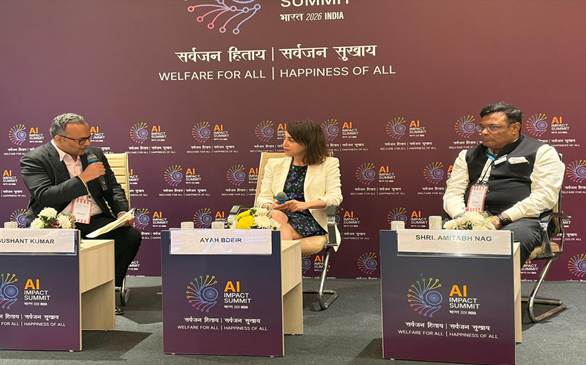
India has taken a groundbreaking step toward inclusive AI with the live demonstration of a pioneering open-source handheld multilingual AI prototype at Bharat Mandapam on February 20, 2026. The session, titled “Making AI for Everyone: The Case for Personal, Local, Multilingual AI,” showcased this compact, voice-first device developed collaboratively by the Digital India BHASHINI Division, Current AI, and Kalpa Impact. Designed as a privacy-preserving, locally deployable system, it operates seamlessly in low or zero-connectivity environments, processing multilingual interactions on-device for real-time querying across diverse languages without needing constant internet access.
This prototype embodies India’s vision of building AI systems that are inclusive, culturally
rooted, and linguistically diverse, serving as a public-interest assistive technology. Its secure, accessible, and scalable open-source hardware model is particularly tailored for rural and underserved areas, addressing the digital divide head-on. During the demonstration, practical multilingual use cases were highlighted, illustrating its potential across India’s vast language ecosystem and proving AI’s viability in resource-constrained settings.
The BHASHINI team presented the device to the Union Minister for Electronics and Information Technology, Shri Ashwini Vaishnaw, who commended the initiative for advancing inclusive, multilingual, and locally deployable AI solutions under the “AI for All” banner. This effort aligns perfectly with India’s digital public infrastructure strategy, blending the nation’s linguistic AI stack with global open hardware innovation to foster strategic partnerships worldwide.
To propel further innovation, a Global Innovation Challenge has been launched, inviting
engineering students and early-career professionals to iterate on the open-source prototype.
This move aims to bolster India’s innovation ecosystem, encouraging grassroots
contributions to equitable AI development. The session also emphasized the critical need to
avert AI monoculture, advocating for systems that safeguard linguistic and cultural diversity while ensuring global interoperability.
By prioritizing privacy, accessibility, and cultural relevance, this prototype positions India as a frontrunner in responsible AI. It offers a replicable blueprint for nations seeking to
democratize technology, ensuring AI empowers every individual, regardless of location or
language. As the world races toward AI ubiquity, initiatives like this reinforce a commitment
to technology that unites rather than divides, paving the way for a truly inclusive digital
future.
Making AI for Everyone: Multilingual Open-Source AI Prototype Unveiled at Bharat Mandapam


RELATED ARTICLES
