

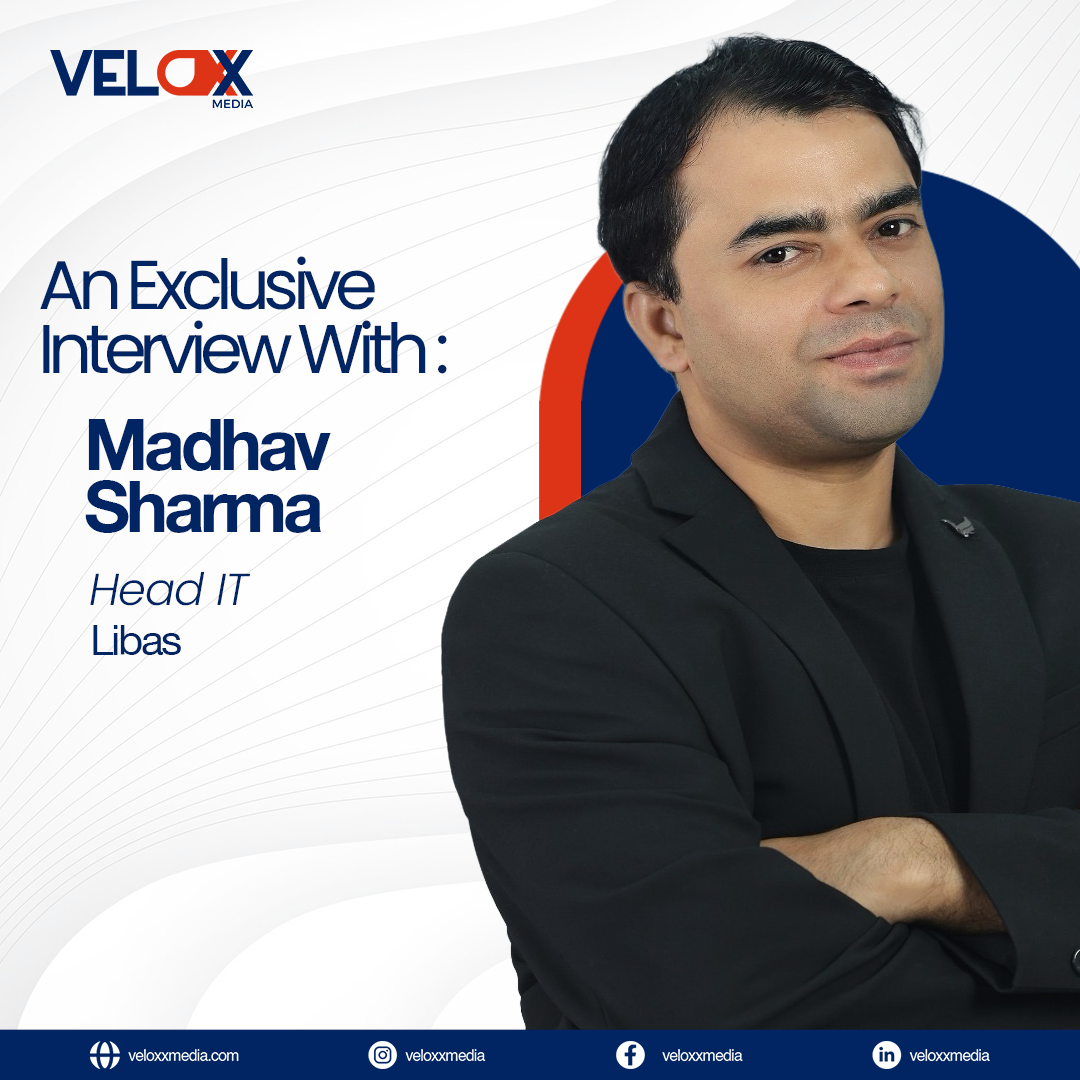
In this exclusive interview with Veloxx Media, Madhav, Head – Digital Transformation, Libas, shares how technology is being positioned as a strategic growth enabler rather than a support function. He highlights the company’s focus on AI-driven operations, omnichannel scalability, integrated digital ecosystems, and data-led decision-making to support rapid business growth. He also discusses the growing role of AI in supply chain optimization, customer experience, and operational efficiency. Emphasizing a secure-by-design approach, he underscores the importance of balancing innovation with governance, compliance, and cybersecurity while building a future-ready retail enterprise.
Below are the given edited excerpts:
1. What are the top technology priorities for you in the next 12–18 months, and how are you aligning them with business growth?
Our technology strategy over the next 12–18 months is centered around building an AI-first, scalable, and compliance-ready enterprise aligned with aggressive business growth and IPO readiness objectives.
Key focus areas include enterprise-wide AI adoption, modernization of legacy platforms, and strengthening our retail and finance technology ecosystem through automation, predictive analytics, and AI-enabled real-time visibility dashboards.
We are also investing heavily in cybersecurity, governance, data intelligence, and scalable digital architecture to support long-term business resilience and operational agility.
As Libas targets 40% year-on-year growth, technology is expected to act as a core business accelerator by enabling scalability, faster decision-making, operational efficiency, and seamless omnichannel expansion.
- In building an omnichannel and D2C tech ecosystem, what were the toughest integration challenges across ERP, WMS, POS, and CRM systems?
One of our core strengths has been building a highly integrated and agile digital ecosystem. Integration itself was never a major challenge for us, as we already operate with over 40 interconnected business applications across retail, finance, supply chain, e-commerce, and customer operations.
Our focus has been on enabling real-time data synchronization, operational visibility, and seamless interoperability between ERP, WMS, POS, CRM, and omnichannel platforms.
The larger challenge was scaling the ecosystem while maintaining data accuracy, process consistency, system performance, and user experience in a rapidly growing D2C and retail environment.
Through API-led architecture, automation frameworks, centralized dashboards, and process standardization, we have built a connected and scalable technology foundation capable of supporting high-growth business operations.
- How did your mindset evolve when transitioning from execution-focused roles to driving business-aligned technology strategy?
The biggest shift in mindset was moving from technology execution to business outcome ownership. Earlier, the focus was primarily on project delivery, implementation, and operational stability. Today, every technology initiative is evaluated through the lens of business impact, scalability, customer experience, governance, and ROI.
This transition required a deeper understanding of business operations, financial impact, customer behavior, and organizational growth priorities. It also meant becoming more collaborative with business leaders and positioning technology as a strategic growth enabler rather than just a support function.
At Libas, technology is now deeply aligned with transformation, innovation, agility, and long-term enterprise scalability.
- With increasing pressure on compliance (ISO, SOC 2, PCI-DSS), how do you balance innovation speed with governance and security?
We strongly believe innovation and governance must evolve together. As the organization scales rapidly and moves toward IPO readiness, cybersecurity, compliance, and governance are becoming foundational pillars of our digital transformation strategy.
Our approach is to build security, compliance, and risk controls directly into the technology lifecycle rather than treating them as post-implementation checkpoints. Whether it is ISO standards, SOC 2, PCI-DSS, or data governance, we focus on creating secure-by-design and compliance-ready platforms without compromising business agility.
Automation, continuous monitoring, governance frameworks, access controls, and standardized operating models help us accelerate innovation while maintaining resilience, regulatory readiness, and customer trust.
- Where are you seeing the most practical impact of AI and automation in retail—especially across supply chain and customer experience?
We are seeing significant impact from AI and automation across supply chain intelligence, inventory optimization, forecasting, and customer engagement.
AI is enabling better demand prediction, real-time inventory visibility, smarter replenishment planning, and faster operational decision-making across the supply chain ecosystem.
On the customer side, AI is helping drive personalized engagement, recommendation engines, faster response mechanisms, and more connected omnichannel experiences.
We are also leveraging AI-enabled dashboards and intelligent automation across retail and business operations to improve agility, predictive decision-making, operational control, and scalable execution as the business continues to expand rapidly.
- What are the biggest technology gaps you still see in Indian D2C/retail brands, and how should leaders address them?
One of the biggest gaps across many Indian D2C and retail organizations is the absence of a truly integrated and scalable digital ecosystem. Many businesses still operate with fragmented platforms, siloed data, and limited real-time visibility, which impacts agility, customer experience, and decision-making.
Another major gap is the limited adoption of AI, automation, predictive analytics, and data-driven operating models at an enterprise level.
In many industries, technology is still viewed primarily as a support function rather than a strategic business driver. That mindset needs to evolve. In today’s digital economy, technology must sit at the core of business strategy and enable growth, governance, innovation, scalability, and customer-centric transformation.
Leaders should focus on building modern technology architecture, AI-driven operations, integrated ecosystems, stronger governance frameworks, and data-led decision-making capabilities to remain competitive and future-ready.

